Tuesday, January 29, 2008

Incommunicado

I'll be incommunicado for the next 10 or 11 days as I'll be doing a Vipassana meditation course in the village of Igatpuri.

Damn, I guess that means I'm going to miss the Super Bowl. Oh well, we must all make sacrifices.
Monday, January 28, 2008

How Enlightening

The part of India around Varanasi was Siddhartha Gautama's old stomping grounds. You may better know him as The Buddha. While Buddhism got its start in India and flourished for a time, at present, Buddhists comprise less than 2% of the population.

Siddhartha was a prince born in present day Nepal about 2500 years ago. Of course his actual history has been obscured by time and myth, but the legend goes something like this: Before his birth, it was predicted that he would become either a great king or spiritual teacher. His father was more excited about the king option and did everything he could to shield the young prince from life's unpleasantness, thinking that would prevent any ideas about a spiritual life. But, as these stories often go, this very shielding created the conditions to turn Siddhartha to the other path. He was pampered, living a life of luxury and sequestered from the world beyond the palace. Eventually, despite his father's efforts, the young prince saw three things that deeply disturbed him: a old person, a ill person, and a dead person. Life's suffering was revealed to him and he was determined to find a way to out of it.

He also came across a religious man, an ascetic, a person who has renounced the world to search for spiritual truths. Leaving his life and family at the age of 29, Siddartha joined a group of ascetics to follow a strict discipline of fasting and self-mortification, the antithesis of his life as a prince. In time he came to see the that the extremes of indulgence and deprivation did not lead to genuine happiness. This is what he called the Middle Way. Determined to reach the the truth about suffering, he sat in meditation under what is now know as the Bodhi tree, vowing not to rise until he discovered that truth. When this was accomplished he became The Buddha, which means "The Enlightened One."

He gave his first sermon to five of his former, fellow ascetics. He talked about the Middle Way and what are known as the Four Nobel Truths. The Buddha has been likened to a doctor, The Four Nobel Truths being the diagnosis, cause, prognosis and treatment of problem of suffering. They are:
  • Life is suffering or dissatisfaction. The way I understand it, this means that we're tormented in big and subtle ways because our lives are never exactly how we want them to be. We have to be around things (and people) that we don't like, we we pine for things we don't have, etc.

  • The cause of this suffering is craving or desire.
  • There is a way out of this suffering.

  • The way out is known as The Eightfold Path: right view, right intention, right speech, right action, right livelihood, right effort, right mindfulness, right concentration. This is The Buddha's prescription for the end of suffering.
I have, on occasion, called myself a Buddhist; mostly to give an quick and easy answer to the question what is your religion?, but I'm not really interested in belief systems especially ones that require nothing more than faith. Buddhism over the years has acquired its fair share of superstitions and fantastic ideas (I've seen plenty of it on this trip) but the Buddha explicitly stated that he was nothing more than a man that saw a way to end suffering.

I've always been curious about why I am the way I am, why I do the things I do and why I suffer. Meditation (right mindfulness and right concentration in the Eightfold Path) is what I find most helpful in that pursuit. What is meditation? I think my Zen teacher's answer to that would be sit down and see for yourself, but I'm not as wise as my Zen teacher so I'll tell you what it is for me: it is a tool for seeing. Sometimes the things we're closest to are the the things we don't really see or question. And nothing is closer than our self. Meditation for me has been a process of looking, questioning and peeling away my beliefs in order to see myself and the world with fresh eyes. I see it as a way of cultivating, peace, compassion and wonder.

We shall not cease from exploration, and the end of all our exploring will be to arrive where we started and know the place for the first time -- T. S. Eliot


Okay, that's enough philosophy.

Since I was in the area, I decided to make a couple of pilgrimages to a couple of Buddhist sites: Sarnath, where the Buddha gave his first sermon and Buddhism's most important site, Bodhgaya, where he attained enlightenment.

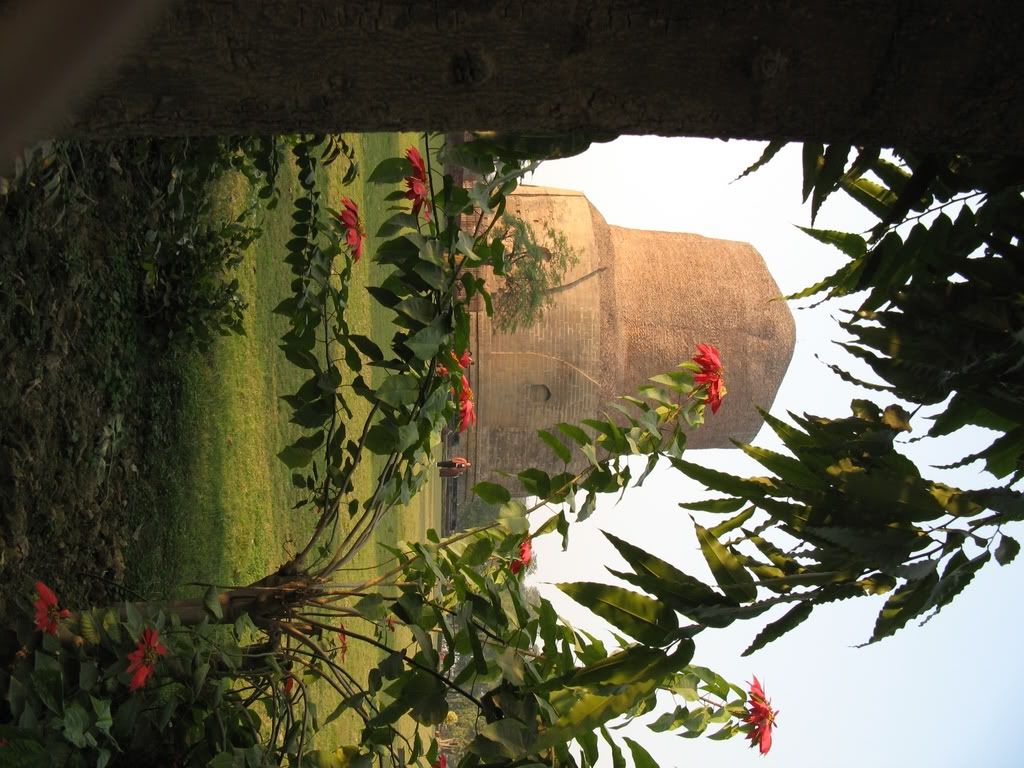
Sarnath is only a half hour ride from Varanasi, so I went there on day trip. It was a open, quiet place and a nice change from exciting but mildly claustrophobic Varanasi. This is the stupa that marks the spot where The Buddha gave that first sermon on The Four Nobel Truths.

Bodhgaya is only a few hours away from Varanasi so I decided to visit for a few days. It turns out the train to Bodhgaya left Varanasi at 2:00 in the morning. Towns and cities in India (and Nepal for that matter) roll up the streets pretty early, so I wasn't thrilled about making my way through the dark, abandoned alleys of the old city to find a ride to the train station so late at night. To my relief, it turns out a guy named Mat was heading the same way--we had had a couple of adventures together in Varanasi and I really enjoyed his company. He's a journalist from New Zealand and is writing a book about his experiences as a recovering alcoholic traveling the world visiting different Alcoholic Anonymous meetings. Around the World in 80 AA's, he's calling it.
At about midnight, we made our way out of the old city to a main street hoping to get a bicycle or auto-rickshaw to the train station. I was immediately glad he was with me. The place looked like some kind of post-apocalyptic vision. There were small fires at every other corner with wraith-like Indians huddled around them. Others were stumbling around in a daze. Someone came up behind us and asked us if we needed a ride somewhere. He looked harmless enough, but the bicycle rickshaw driver he roused certainly didn't. I don't know if he was still half asleep or on something but I was happy it was a bicycle and nothing that could go more than a few miles an hour. After haggling for a fair price, we slung our packs onto the rickshaw and headed to the station. Even though the rickshaw was completely open, it gave me enough psychological distance from the otherworldly Varanasi night that I was enjoying that exhilarating sweet spot that lies between uncertainty and fear.

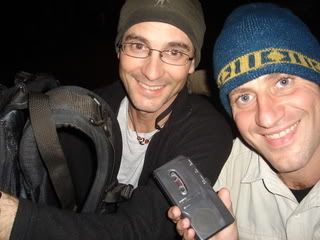
After about five minutes into the ride, the driver, struggling under the load, spins around and hands us a screeching micro cassette player. "Music," he said. Mat took it in his hand; we looked at each other and busted up laughing. You just never know what's going to happen in India, you really don't. The tape would speed up and slow down or just stop until we gave it a good whack. It was painful to listen to, but when we learned it was music from his wedding we decided to keep it on till we arrived. Mat snapped a quick picture.
The train station looked like a refugee camp. There were literally hundreds, perhaps thousands of Indians sleeping on the floor in neat rows. I assumed they were all waiting for a train, but who knows. The train was an hour late, but I easily found my berth and had an uneventful if not chilly ride to Gaya. It was another half hour ride to Bodhgaya by auto-rickshaw.

Bodhgaya is a dusty, little town whose sole existence seems to be due to the Mahabodhi Temple, which marks the spot of the Buddha's enlightenment. Many countries, including Thailand, China, Japan, Tibet, have built temples in the surrounding area, some of them quite beautiful. The town was filled to capacity with monks and other pilgrims because the Karmapa lama was in town giving teachings. Apparently he's next in importance after the Dalai Lama in Tibetan Buddhism.

While I was getting settled in the hotel, Mat went out to get some tea. When he returned, he told me he had met a "nice Indian kid who bought me some chai." "I've got a good feeling about him," he added. We'd both been in India long enough to mistrust any English speaking local that approached us, so the second comment was necessary. Mat invited me to join them for a walk around town. I accepted the offer.

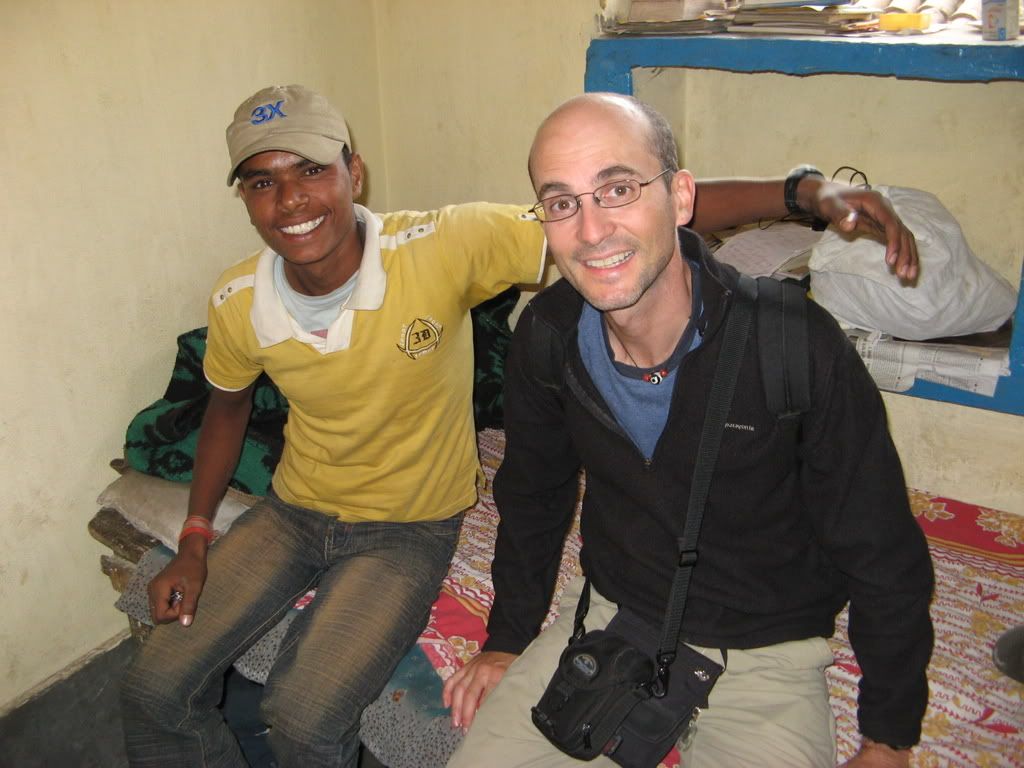
Sure enough, he was a nice guy. He was very personable and I liked him immediately. His name was Rohit and he claimed to be a seventeen year old college student. The three of us walked around for a while, Rohit telling us about his life in Bodhgaya. At one point, he asked us what we were up to next. Mat and I were hungry and agreed that lunch was our next step. "Why don't you come out to my village for lunch," he offered. We readily agreed, both curious and excited to visit a local's home. "First I have to borrow a friend's motorcycle," he said. After a short walk we came to a guest house where we met some of his friends, also very nice guys. They were older and one of them, it was casually mentioned, worked at a local orphanage. A flag went up for me. Bodhgaya is in one of the poorer regions of India and many charity organizations have set up shop there. Unfortunately, this has led to a slew of fake ones: the local scam. Once again, the Lonely Planet came through, as I'd just read the warning the day before.

The three of us got on the motorcycle and headed out to his village. Mat had forgotten his camera so we stopped at the hotel to pick it up. Rohit stayed with the bike and I went in with Mat. "I think we're getting scammed," I said. Mat shrugged, "they're not getting any money out of me." I agreed. What the hell, let's go with it, I thought.

It was a short ride to the village where we zipped passed goats, drying grain and women in colorful saris carrying urns on their heads. We stopped at one of the many mud brick houses and were introduced to Rohit's "family." After brief introductions, we were ushered into Rohit's "room."

At this point it was so obviously choreographed that I was almost laughing. Less than ten minutes after we arrived a big plate of dahl and rice appeared.
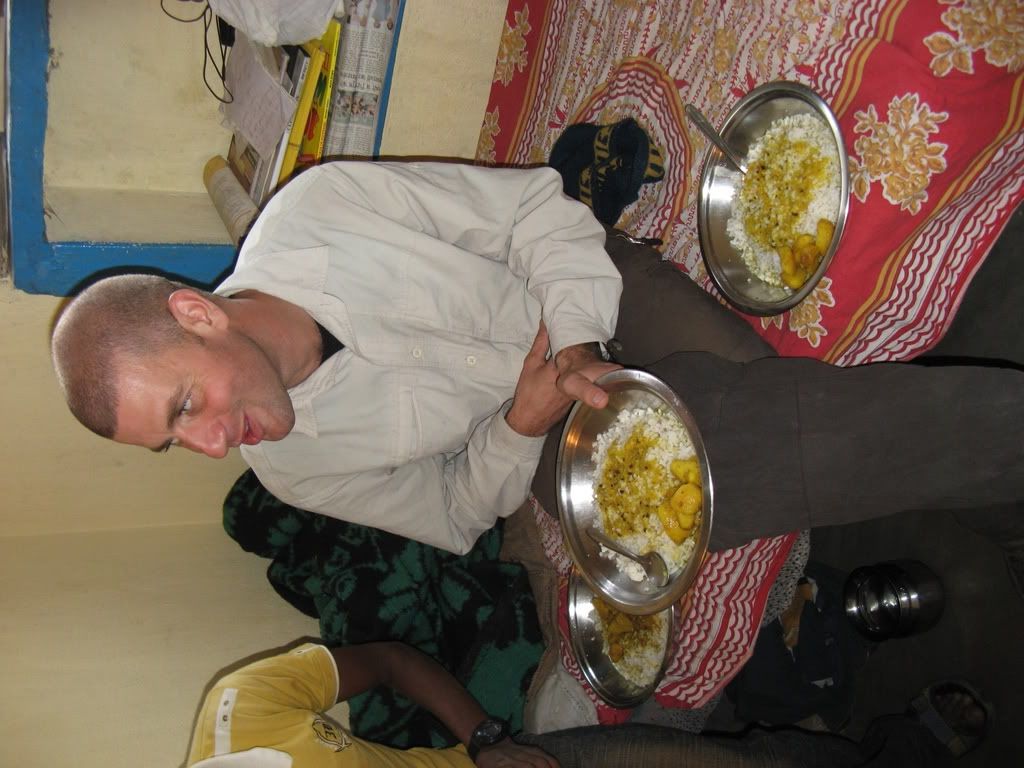
Shortly after that, Rohit's "uncle" came into the room. He also worked at the orphanage that was so casually mentioned earlier. And finally an incredibly cute little boy and his English book found his way into the room. He is, of course, one of the orphans.
"Do you want to go on the roof to get a better view of the village?," Rohit asked. "Sure, why not?" We made our way to the roof where the school for the orphans was pointed out. That's when a binder, with all their good works, was sprung on us. "Perhaps you'd like to help out?" Mat and I, knowing what was up, decided to play a little, too. "Of course we would! This is such wonderful work you're doing. We would love to help." We then made a big show of handing over 100 rupees each ($2.50). We had decided this was worth lunch and the entertainment. Luckily there was no complaint about the amount, but suddenly, a now deflated Rohit decided that "we'd better be getting back."

Knowing it was a scam we had fun with it, and we did get to see a bit of life outside the cities. I've had moments since when I've wondered if, perhaps, they were on the level. But, either way, we were lured out to the village under false pretenses. Incidentally, in a The Usual Suspects moment, that night at dinner, I noticed the name brand of our bottle of chili sauce was--Rohit.

My intention was to do a short meditation class or retreat at one of the few centers in town but they were either closed, between courses or busy with the big event. I did take advantage of an hour of zazen, or Zen sitting meditation, offered in the evenings at the local Japanese temple. This is tradition in which I received my first meditation instruction and have worked with since, so I was right at home. The event with the Karmapa was also open to the public, so I was able to attend that as well.

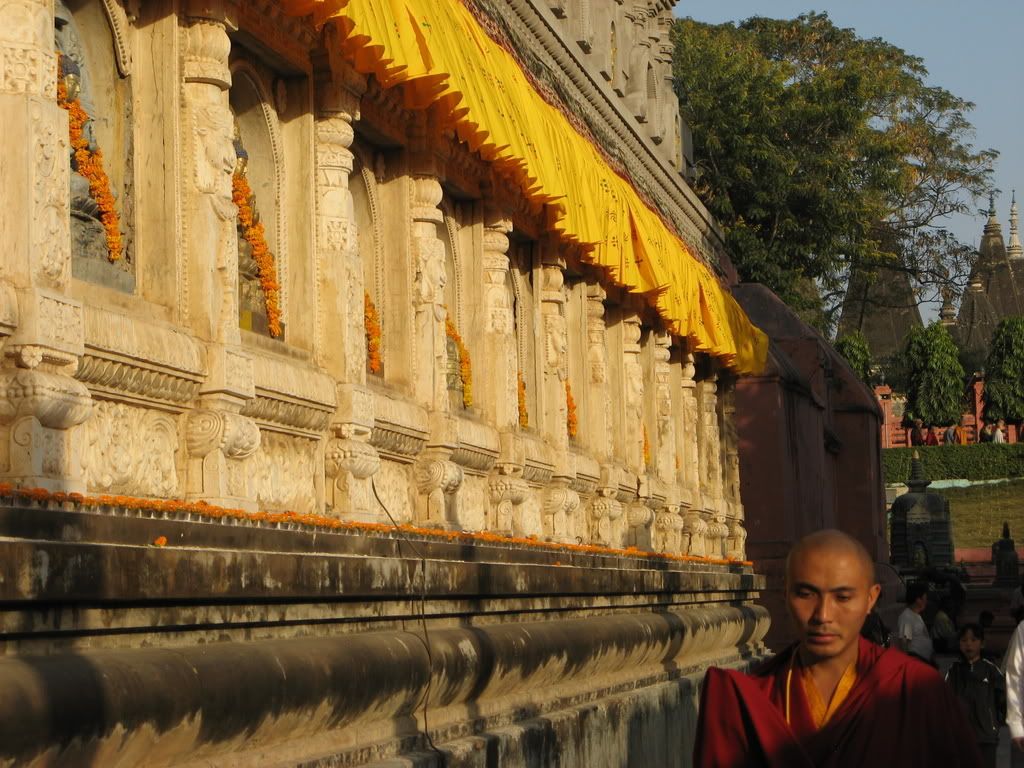
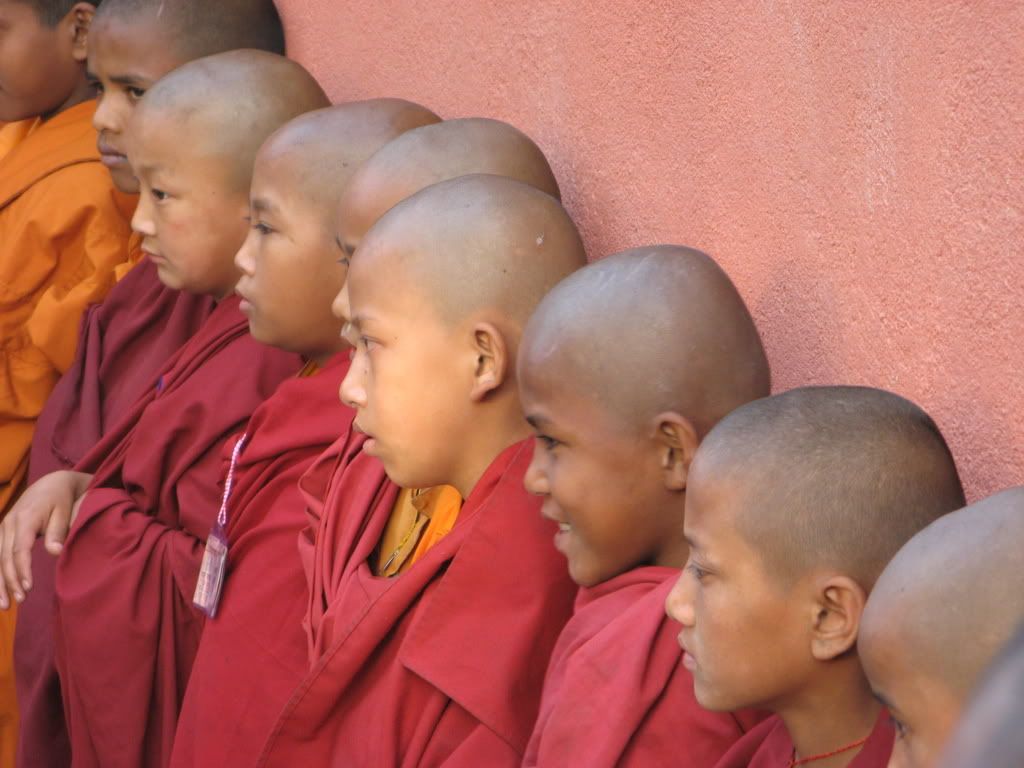
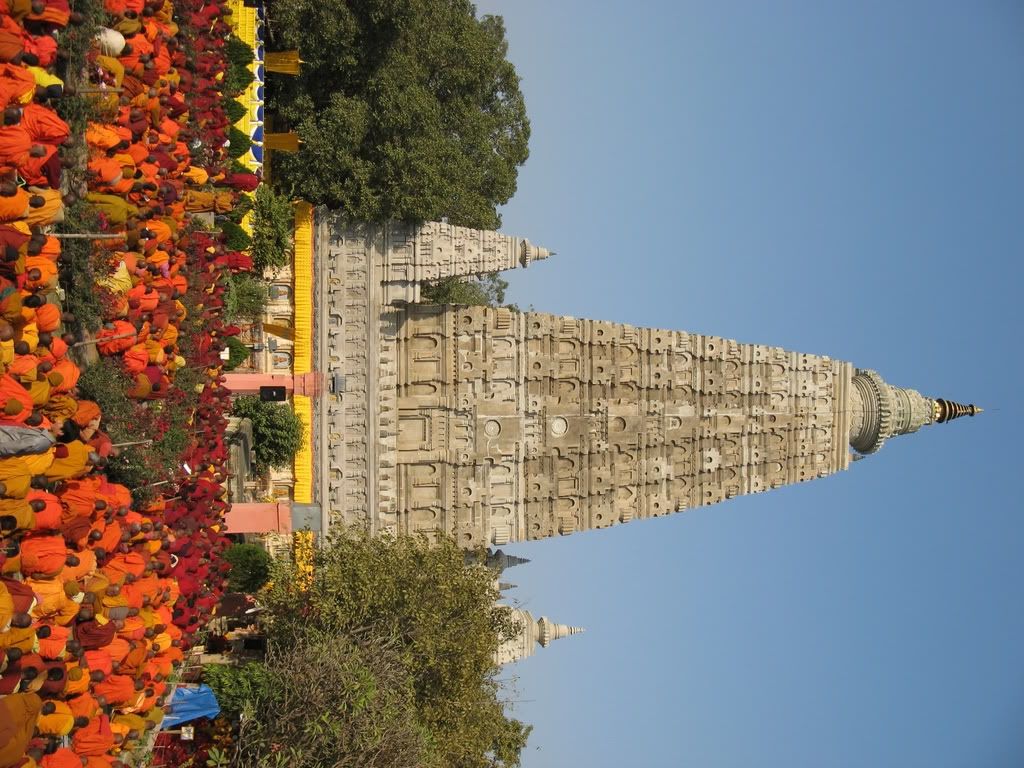
The Mahabodhi Temple sits next to the spot where Siddartha attained enlightenment. The temple is surrounded by gardens and is quite beautiful. When I had imagined the it, I pictured it as a calm, quiet place, but with the Karmapa there, the temple and gardens were overflowing with people, mostly monks in maroon and saffron colored robes. There were events all day long but I couldn't understand anything--it was all in Tibetan--but the times I went, it was mostly chanting so it didn't matter much.

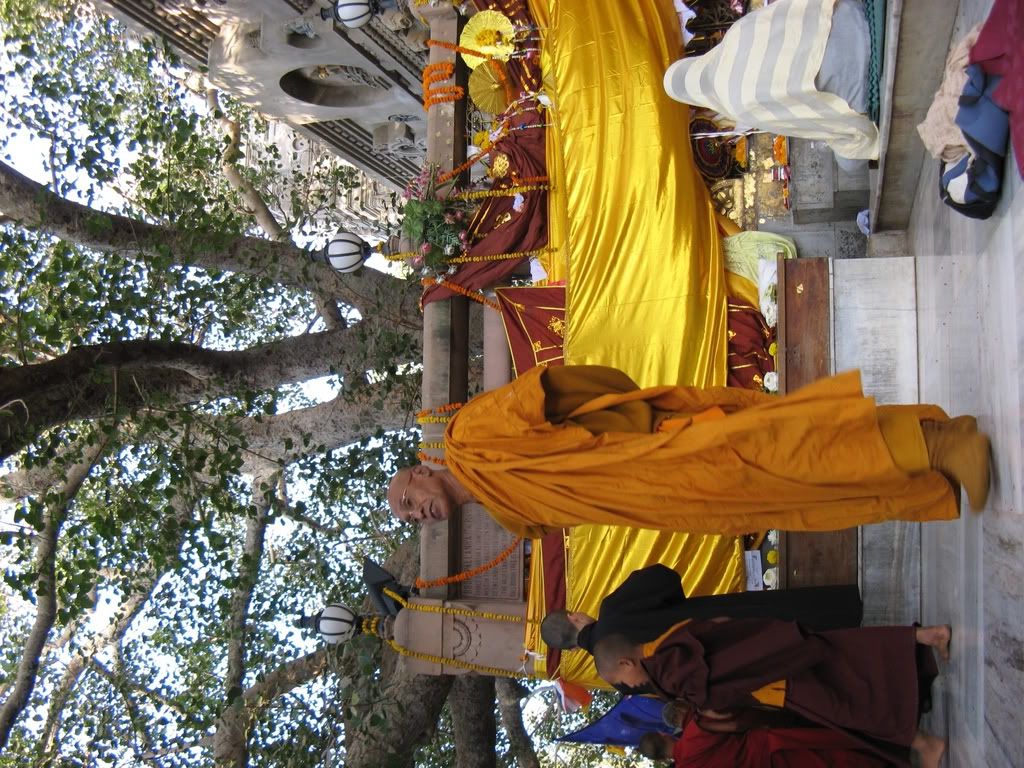
The Buddha attained enlightenment while sitting in meditation under what is now known as the Bodhi tree. In the picture below, that tree is the one you see just to the left of the temple (actually, it's a descendant of the original tree). You can also see a few of the monks attending the teachings of the Karmapa.


It's hard to tell from the picture above, but there's something of a high fence that separates the gardens (where the monks are) from a wide walkway around the base of the temple. The fence made it possible to visit the Bodhi tree, even though it was the focal point of this huge gathering.


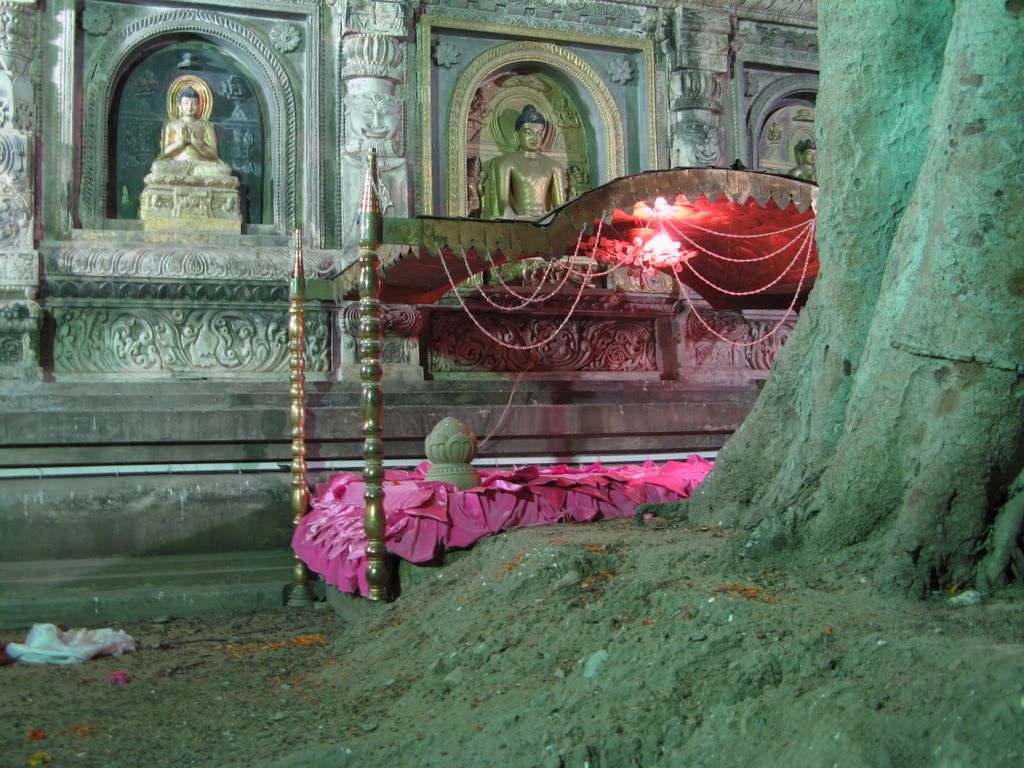
The picture above was taken in the walkway I mentioned. The tree behind the fence is the Bodhi tree. As luck would have it, there was space for me to sit on a ledge along the fence. This picture was taken my vantage point. There were a few monks sitting next to me and they made me feel right at home. Some of the young monks would come around with big kettles of chai and those around me made sure I got a cup. I can't tell you what a wonderful experience this was. Just behind me hundreds of monks were chanting in Tibetan (beautifully, I might add) while I was sitting about 50 feet from the place of the Buddha's enlightenment. It was quite powerful.


In the picture above, you can see the actual spot under the Bodhi tree where the Buddha attained enlightenment, marked by the "Diamond Throne."

A couple more Bodhgaya pictures:

I ended up staying in Bodhgaya for a few days, immersed in the mystique of the place. I left on Christmas Eve. That was the day of that trying 17 hour train ride I mentioned in a past post. Next stop: Agra, home of the Taj Mahal.
Sunday, January 6, 2008

Varanasi

Okay (finally), here's my post on Varanasi. This was my next stop after Delhi...wow, about three weeks ago.

I can't say I've been anywhere in the world that is even remotely like it. One of the oldest continually inhabited cities in the world, people have been living here for possibly longer than five thousand years. It lies on the west bank of the river, Ganges, and is one of India's holiest places as well as an important pilgrimage site. The Ganges is considered sacred, an incarnation of the goddess, Ganga. People come here to bathe in the river, which, according to Hindu belief, washes away their sins. It is also understood that dying here will ensure an end to reincarnation, the cycle of rebirth (in case you're wondering, this is considered a very good thing).

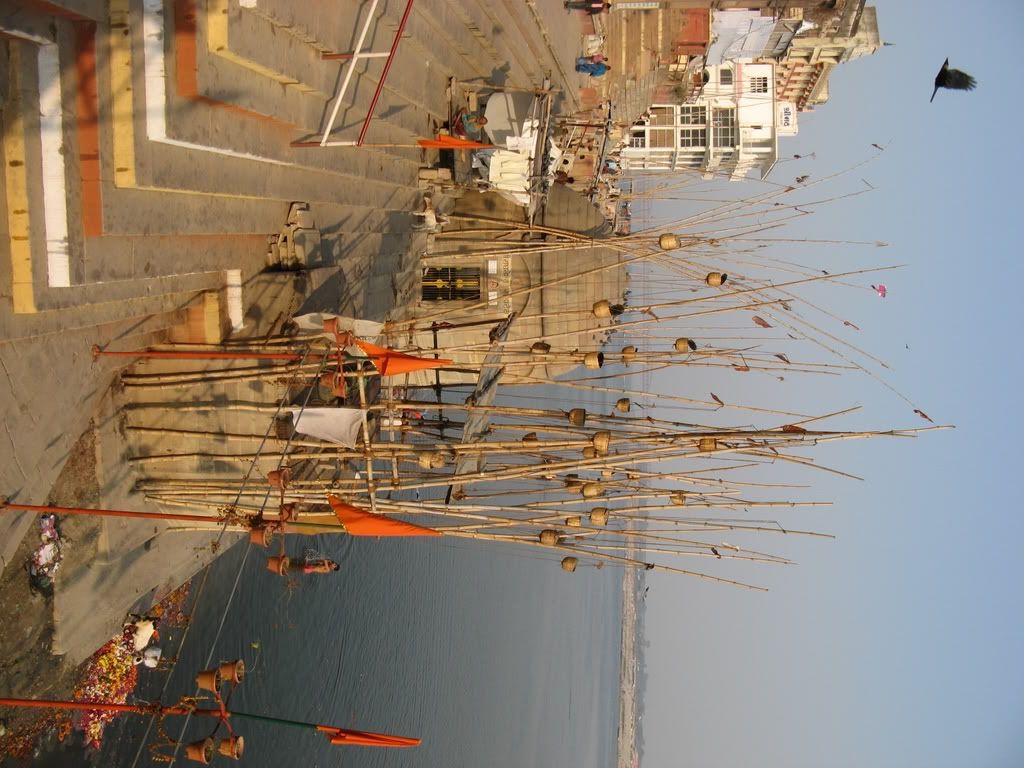
Life here is centered around the ghats, the large steps that lead down to the river. Most of them are for ritual bathing, but there are at least a couple of cremation ghats, as well.

During the day, the ghats are filled with tourists, pilgrims, yogis, locals, you name it. It's a very social place and because there are people here from all over India and the world, unbeatable for people watching. You can buy chai in an earthenware cup from a wandering chai guy:

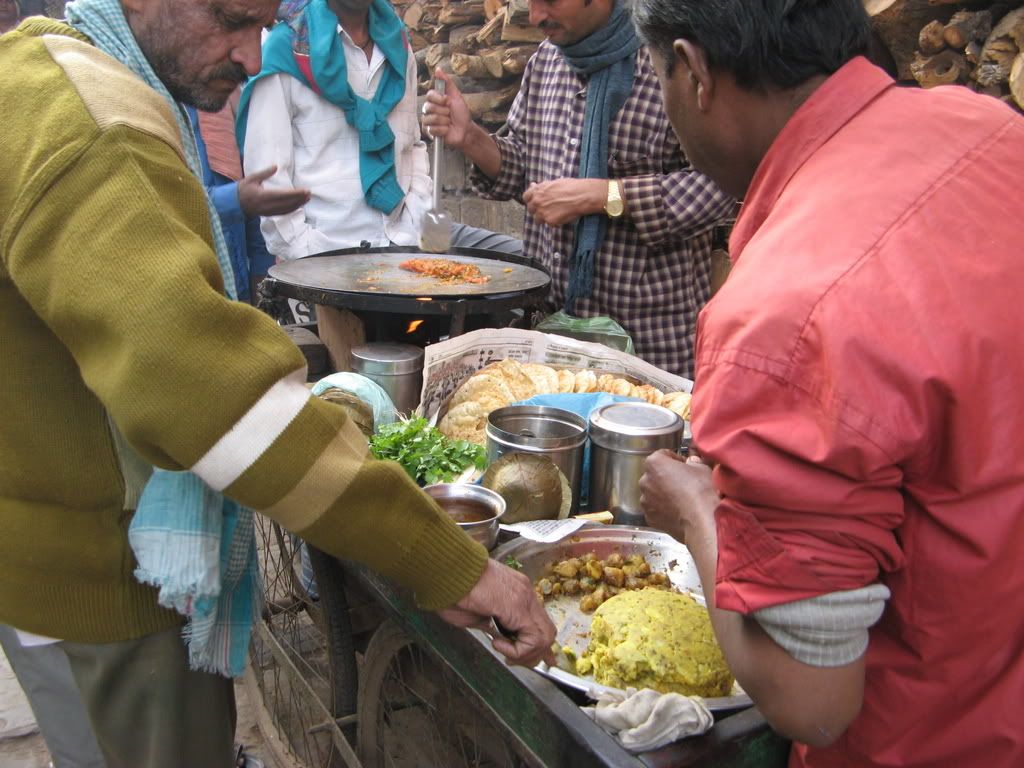
Get a bite to eat:


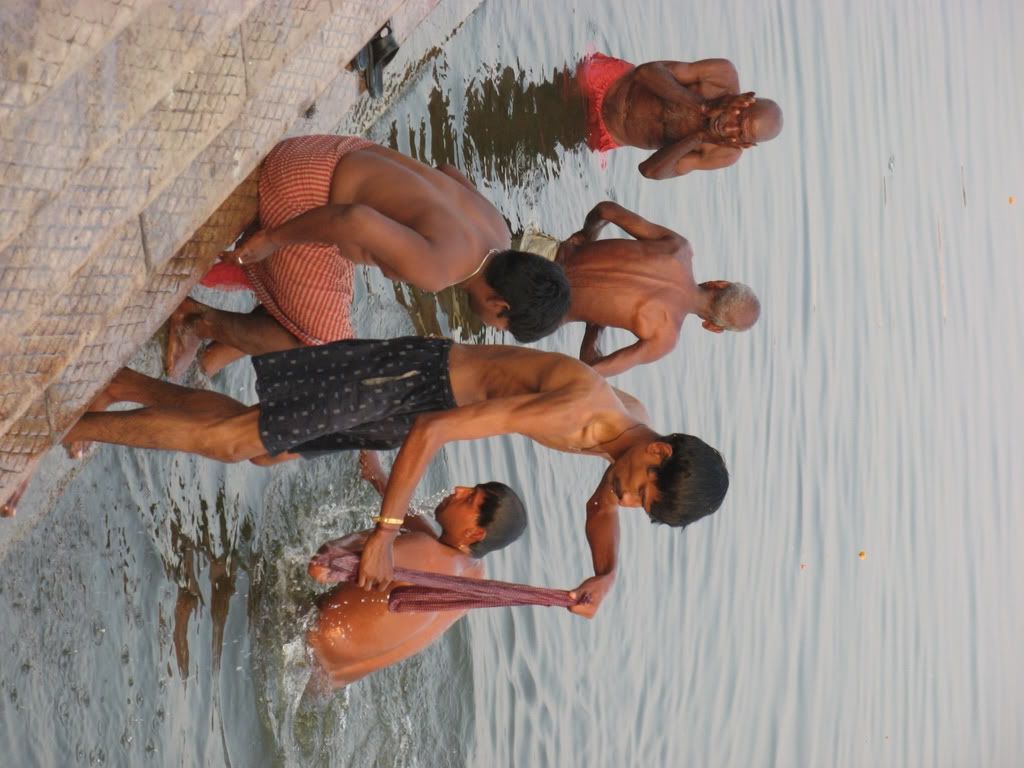
Or wash those sins away. Now, I have to point out--I guess I don't really have to point it out, but I'm going to--that the Ganges here in Varanasi is incredibly polluted. From the Lonely Planet:

Every day about 60,000 people go down to the Varanasi ghats to take a holy dip along a 7km stretch of the river. Along this same area, 30 large sewers are continually discharging into the river...Samples from the river show the water has 1.5 million faecal coliform bacteria per 100ml of water. In water that is safe for bathing this figure should be less than 500!

Knowing this, I would cringe every time I would watch scenes like this:

Oh, and they drink it too.

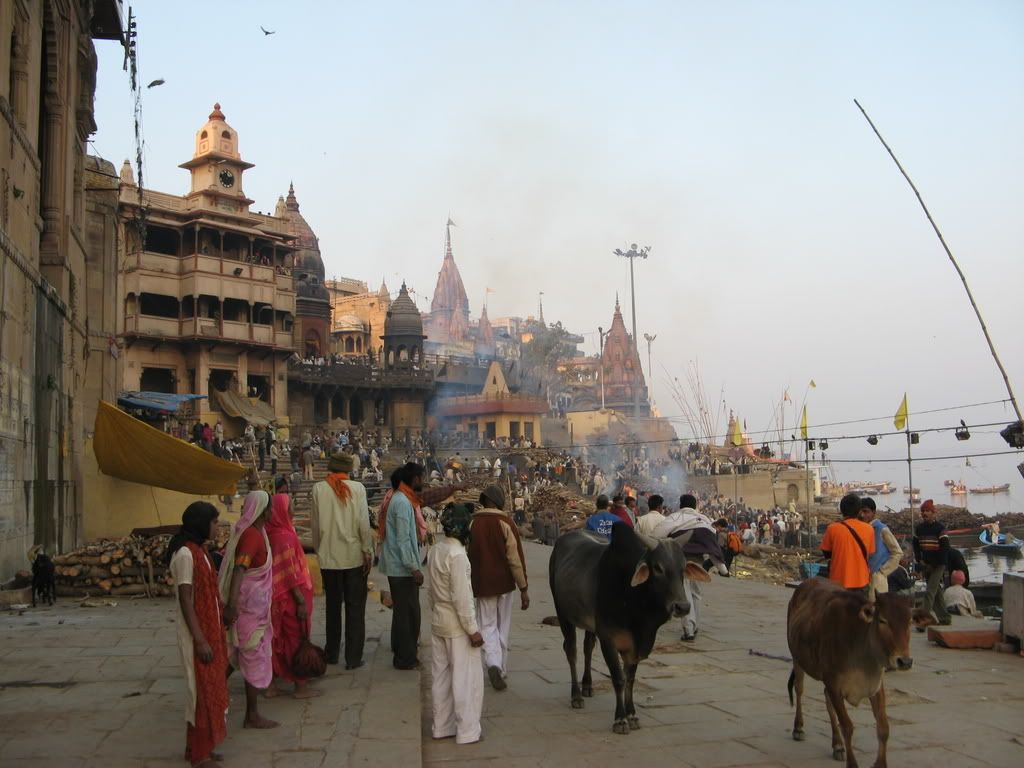
But the most surreal thing about Varanasi is the burning ghat, where literally hundreds of bodies a day are cremated around the clock. Unlike our cremations, these (at least at this ghat) are done out in the open on wood pyres. There are usually around ten or so going at one time, on different platforms, at different heights. Where you're burned and what kind of wood is used (Sandalwood is most expensive) depends a number of things, including your caste and how much cash you have stashed away. Here's a photo of the largest burning ghat, Manikarnika, which just happened to be very close to my hotel (I could sometimes smell the smoke as I was drifting off to sleep...mmm). You can walk right up to the area where the bodies are burning, but this was about as close as I could get to take a photo without being culturally insensitive (and risk having my camera thrown in the river).

Coming from a culture where death is so often hidden away, I found it extremely fascinating to watch. As you might imagine, there's quite a ritual that goes along with the cremation, one that I never did figure out entirely (I also got conflicting accounts from various people, including Indians) but, with that disclaimer, this is what I remember: The bodies are wrapped in bright multi-colored cloth and placed on a bamboo stretcher that is carried by family members through the town to the ghat. They chant "Ram nam sach hai! Ram nam sach hai!"-- The name of God is truth! After dipping the body in the Ganges, the eldest son--whose head has been shaved except for one small tuft of hair--lights the fire. There are people whose job is to burn the bodies, members of a low caste. They watch over the cremation, which usually takes a few hours. Afterward the pelvic bone if it's a woman or the ribcage if it's a man are deposited into the Ganges--for some reason these bones don't burn completely. I didn't notice any weeping, or emotion of any kind, for that matter; but only men are allowed to attend because women can be "too emotional." It all seemed so efficient and matter-of-fact which only made the whole thing more surreal. The air is thick with smoke but, thankfully, only smells like a pleasant campfire. Most of the pyres just look like piles of burning wood, but on a few of them, the human form is easily recognizable. I didn't find it disgusting or repulsive, even when one of the attendants started moving a body around to get it burning better. It was just so intensely interesting (I don't know what that says about me). But that's one of the things I love about travel, you see things that are so out of your normal range of experience that, for me at least, my brain shuts down its continual commentary and I just get the unadulterated sensory experience. I love those moments.

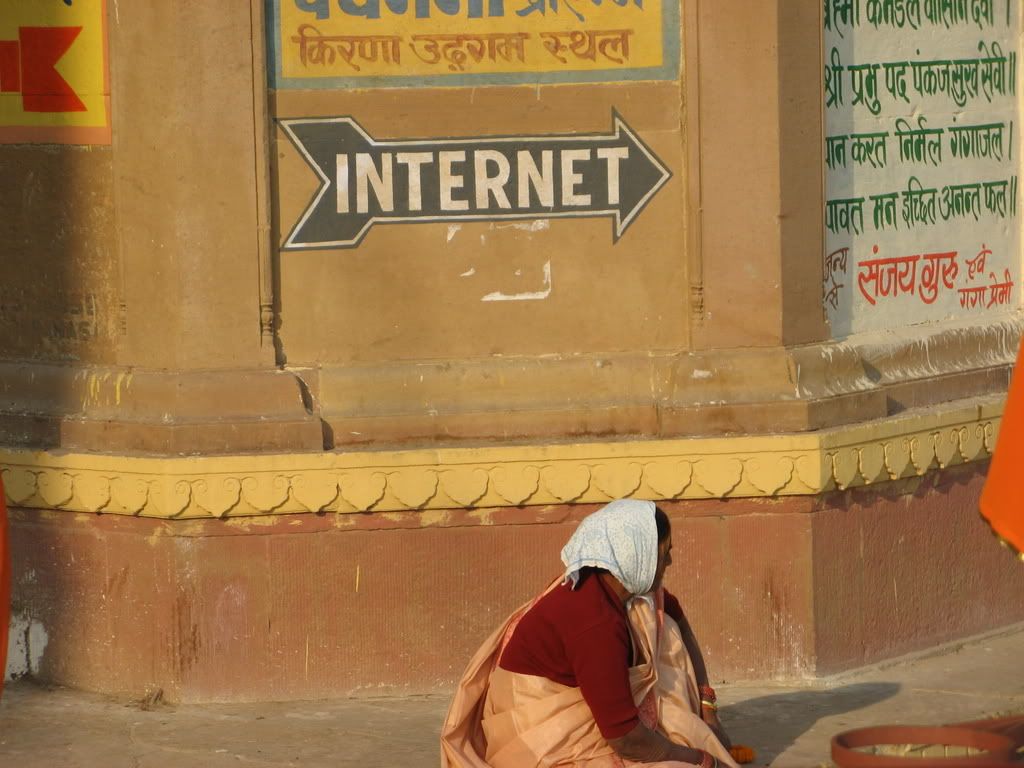
The area around the burning ghat is busy with business of burning: head shaving, people weighing wood, the selling cloth and other burning paraphernalia. Have you ever been to the ruins of an ancient place and wished you could go back in time to see what it actually looked like when it was inhabited all those years ago? Along with the flaming bodies, I think that is what I found so intriguing about the burning ghat. The place and the ritual is ancient so there was a real sense of having gone back in time--minus all the signs for the Internet, of course.


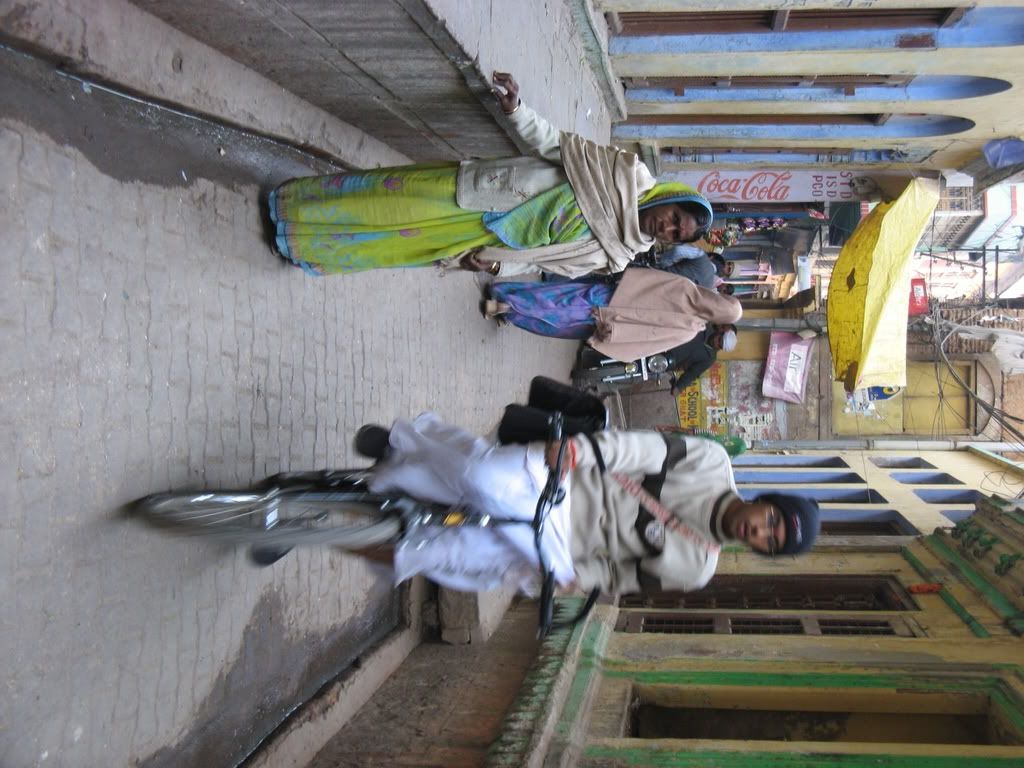
As you move away from the river and into Varanasi, the old town is a maze of alleyways that, in most places, aren't more than ten feet wide. Walking these narrow lanes was one of my favorite ways to spend the day. They are filled with bicycles, motorcycles, people, and unattended animals of all kinds, from goats to huge water buffaloes. Those funeral processions were always going by, too--I was always afraid I was going to accidentally trip one of the stretcher bearers, sending somebody's recently passed relative tumbling down the street. There are temples and shops (silk is big here) and alley-side vendors selling everything from from food to incense to paan, a popular I-don't-know-what-to-call-it of various ingredients wrapped in a betel leaf. It is chewed, producing bright red saliva which is then spit out (usually to the place you're just about to step). Because of the narrowness and many stair cases most motor traffic (some motorcycles still speed through) is eliminated which made for a much more peaceful experience than most of what I've seen so far in India.


It was a wonderful blend of colors, smells, sounds and faces and I'd walk for hours at a time.

Fortunately, no matter how lost you get, you eventually end up back at the ghats where, hopefully, you've memorized a route back to your hotel.

One night while I was out strolling, a yogi approached me on one of the ghats and asked me to come check out his "studio" to see if I would like to study yoga with him. I was hesitant, but had been wanting to try out some yoga in its birthplace. He finally talked me into it--I think mostly because he just looked the part. His studio turned out to be his one room "apartment." I really didn't want to do a session that night but after some more cajoling I agreed to a two hour lesson of "real yoga," not that "exercise you get in States." We went up to the roof of his building where it was a beautiful, warm evening bathed in the setting sun's last rays. I was just tickled at the whole scene. The two of us sitting crossed legged on a big blanket, his grey beard, long beaded hair and robes. The session started off with the philosophy behind yoga and this came mostly in the form of a questions about what I thought yoga was, who I thought God is, what is concentration, what is meditation, and a number of other things. I tend to think a lot on these kinds of things and the meanings have become slippery to me, so my answers were filled with maybes and not-sures. This coupled with the fact that it took so long for me to make up my mind about doing the session in the first place was getting him slightly exasperated. To him, this was all a sign of how much training I needed. Your meditation is "primary school," he said. It was all said in a good-natured way and I took no offence. I remember at one point he asked me how my wife dealt with me and my indecisiveness. "I'm not married," I said. "Girlfriend?" "No, I don't have one of those either." He shook his head in a way that said, yup, no surprise there. We finally did get around to some meditation and yoga. It was nice, but really didn't impress me. We ended with a short walk around the town and a cup of chai. He tried to get me to commit to another session the next morning but I couldn't decide if I was up for it or not.
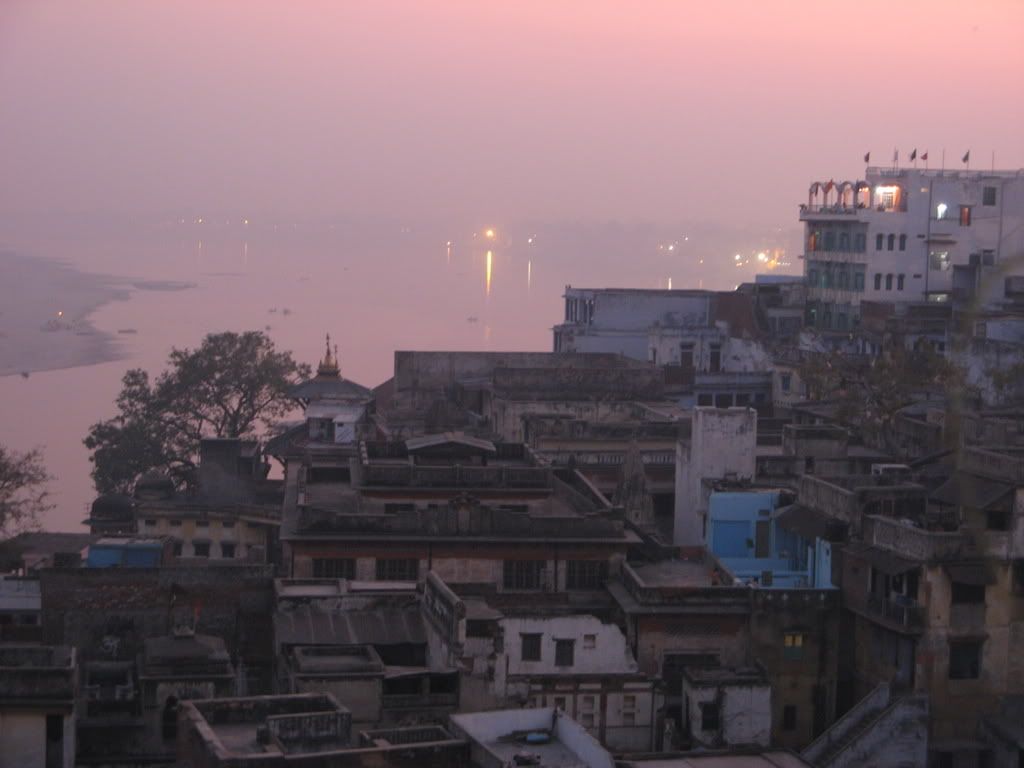
I also enjoyed my hotel, The Shanti Guesthouse. Physically, it is the worst place I've stayed so far. When I walked into the hotel, they were hosing the place down like a cell block. My room looked and smelled like a dank basement, barely lit by a single compact fluorescent bulb. The pink paint was peeling off the walls and the bed's mattress was about an inch thick, accompanied by a scratchy, wool blanket. Why would I love such a place? The $3.75 a night price tag didn't hurt, but the rooftop restaurant is what made this place. The food was just okay and the decor could use a makeover. In fact the only thing going for it is the great view. Here's the Ganges in the late afternoon:


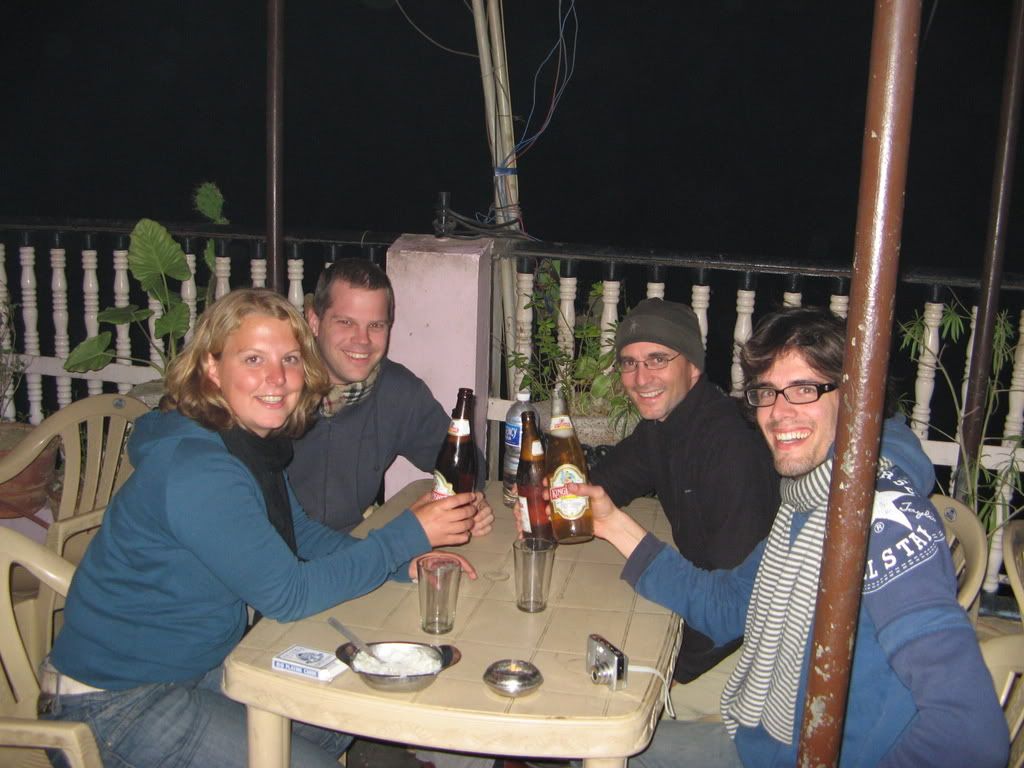
Actually, what makes the restaurant (and the hotel) great is the social scene. I met so many fun and interesting people here. The place was very relaxed and laid back. Some days, a bunch of us would spend entire mornings drinking tea and swapping stories. Evenings were great for playing cards and drinking beer.


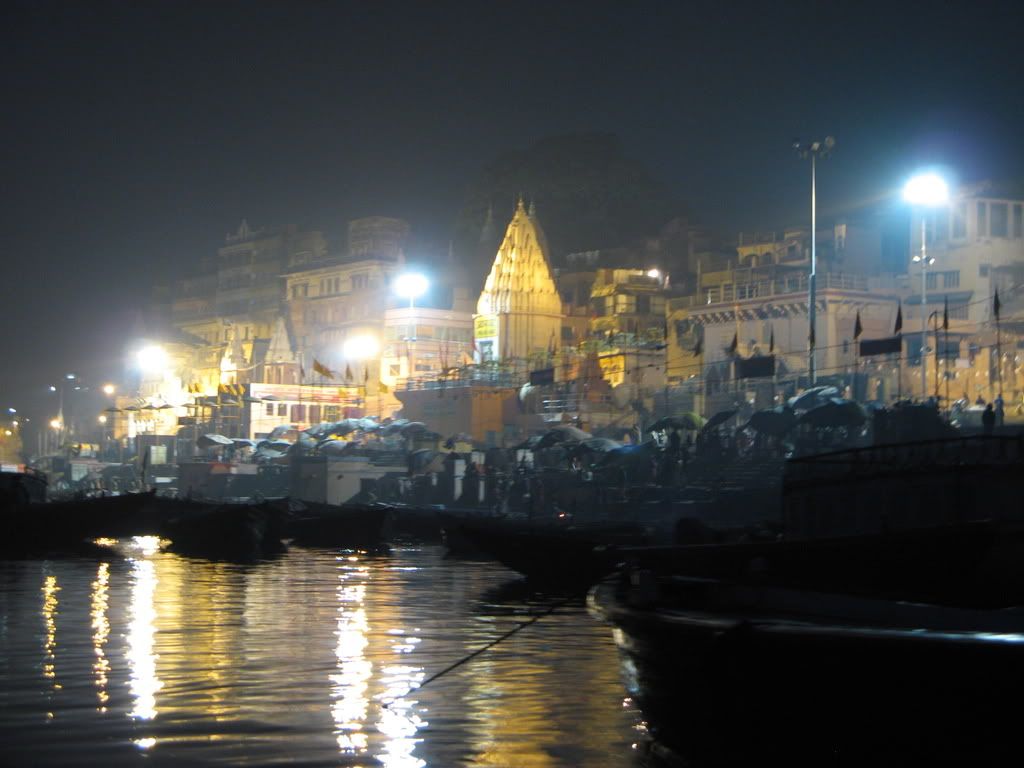
The hotel even had free boat rides on the Ganges in the morning and evenings. Here's a night shot of the ghats from the river:

For some reason I seem to end up hanging out with Europeans. I'm not intentionally avoiding Americans (and now that I think about it, I haven't met many Americans). It just seems to be working out that way. It's interesting how the cultural differences between us seem insignificant, almost invisible, in India. This is, of course, with the Europeans that speak English, which is most of them. In fact many of them speak a number of languages. I have to say I sometimes feel embarrassed that I only speak one and have also had horrible moments when I wonder if their English is better than mine--the non-native speakers that is.

Okay, one more story: One morning as I was on my way up to the restaurant at the hotel, I ran into a couple hastily making their way down the stairs, toast in hand. "I wouldn't go up there," they said, "there's a monkey on the loose." I, of course, immediately picked up the pace. I had been seeing monkeys around the restaurant since I arrived (sometimes they'd jump on the roof, mischievous little devils), but this was the first one that had come inside. As I reached the last flight of stairs, I could hear shouts and other sounds of commotion. There was a Dutch guy, Florin, that I knew, backing his way down the steps with a broom held out in front of him. He was visibly shaken and told me the same thing: monkey on the loose. "He's eating people's breakfast and drinking tea!" Now this I had to see. We made our way up the stairs, Florin still holding the broom out in front of him. As I got a view into the restaurant, I could see people cowering behind tables and the staff hiding behind the door to the kitchen. Sure enough, there was a monkey sitting on one of the tables, looking aggressive and baring his teeth. When he caught our eyes, he launched himself towards us! We spun around and bolted down to the next floor. Looking over my shoulder I saw the monkey scurry past us and down the next flight of stairs. Worried he would come back, we frantically started trying all the doors on the floor, looking for a place to hide. He didn't, but what fun.
Just in case you're thinking, oh geez, it's just a little monkey, here's a picture to show you what we were up against. Okay, it's not the monkey (I took this at the "Monkey Temple" in Kathmandu). And, to be honest, I think this one was just yawning:


As you can probably tell, I loved Varanasi. Like Delhi, there were plenty of people with their eye on my wallet, but it also had a gentle, comforting quality about it, too. Many travelers I talked to agreed. And I spent an afternoon talking to someone who really did want to practice his English.

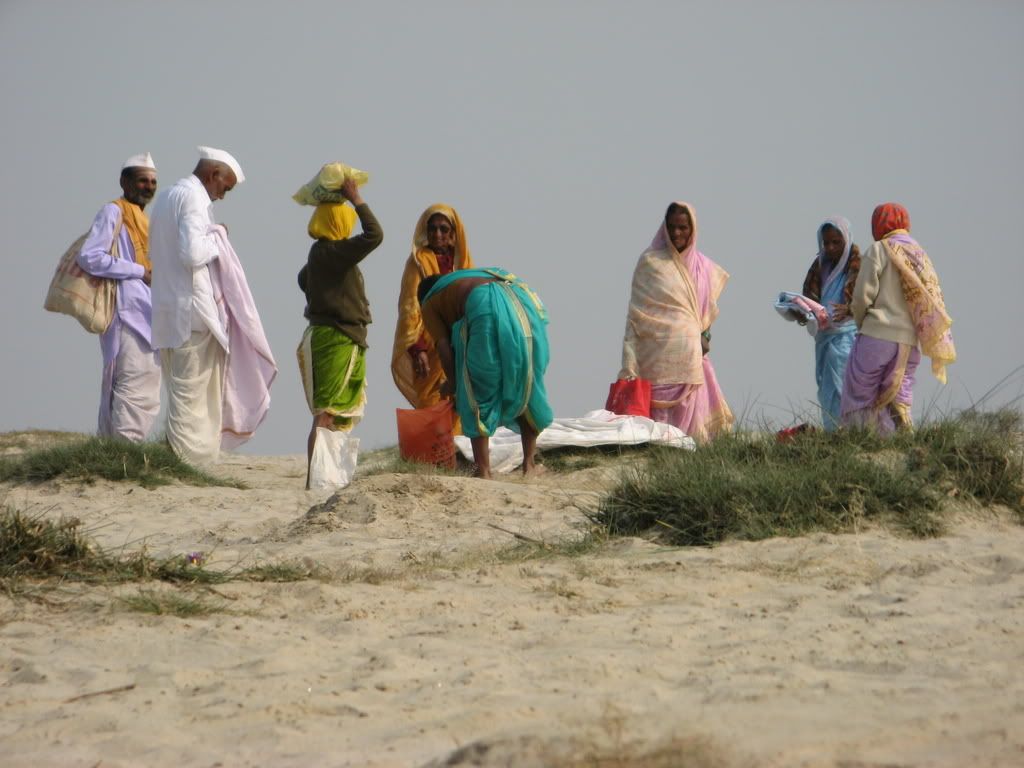
I'll leave you with one of my favorite photos from Varanasi, taken on the shore opposite the ghats. They're wrapping up a little picnic I think.


Tuesday, December 25, 2007

Merry Christmas and/or Happy Holidays

Hello everyone. I'm in Agra, home of theTaj Mahal, after yesterday's grueling 17 hour train ride.

I wasn't able to get a reserved seat, but the travel agent said, "Oh, it's a day train, so it's no problem, just find a place to sit down." My ticket was for "sleeper class" and this made sense, I thought, since the sleeping compartments would be set up for sitting rather than sleeping. In this configuration, the upper berths would be open and I could just lie down and read, nap or listen to my iPod. No problem. Well, it worked that way for the first half of the trip. At some stop, though, the car started filling with people...and more people...and more people. To make a long story short, I ended up in that same berth with two other guys and a bunch of luggage. Being so close to the ceiling, I couldn't sit up, or lie down, completely. I'm amazed my neck isn't sore today. As horrible as that sounds, it wasn't complete torture. Even though there were so many people packed into that car, somehow it felt like we were all a big family. The Indians were very generous and gracious. The people whose berth I was sitting in put off their bed time when the train was late and made space for me at the end of one of the lower berths when the train ended up being very late. And the couple of guys that were sharing the berth with me bought me chai and shared their peanuts. So, as happy as I was to get off that train, for the circumstances, it couldn't have gone any better.

So, it's a lovely day here in Agra. My hotel is only about 100 yards from the outer wall of the Taj Mahal and the rooftop tables have a great view, the perfect backdrop for my lunch this afternoon. Today I'm mostly relaxing (strangely enough, with eight months, you'd think that I'd have a lot of days for just relaxing, but that hasn't been the case). I had a couple of nice chats with my dad and brother this morning that made me very happy. Tonight my hotel is having a Christmas party in their restaurant, so hopefully I'll meet some nice folks to celebrate with; but right now, my thoughts are of all of you, missing you and hoping you're all having a great day.

Tomorrow, I'll do the sight seeing, getting up early to see the sun rise on the Taj Mahal.

Oh, I've got a couple of posts in the works on my trips to Varanasi and Bodhgaya, so stay tuned.

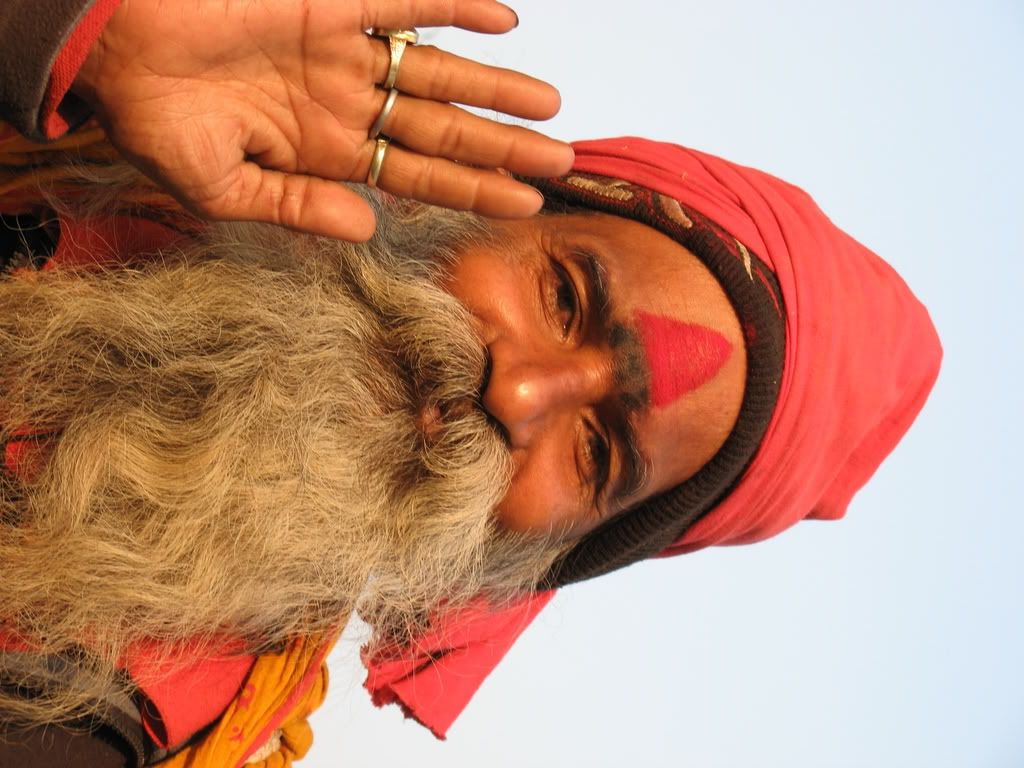
Here's a picture I took in Varanasi. I didn't realize it at the time, but looking at it now, he sort of looks like an Indian Santa Claus.


Thursday, December 13, 2007

Gettin' Out of Delhi

I'm happy to say I'm getting out of Delhi today, taking an overnight train to Varanasi.

I hope the last post wasn't too depressing. It was a bad day and then I sat down in front of a computer.

But it's all part of the adventure and reminds me of a tag line I read on someone's post on an Internet forum somewhere: "Adventure is emotional and physical discomfort recalled in a state of tranquillity." I want to send a big thank you to those of you that sent me words of encouragement and virtual hugs. It was very much appreciated.

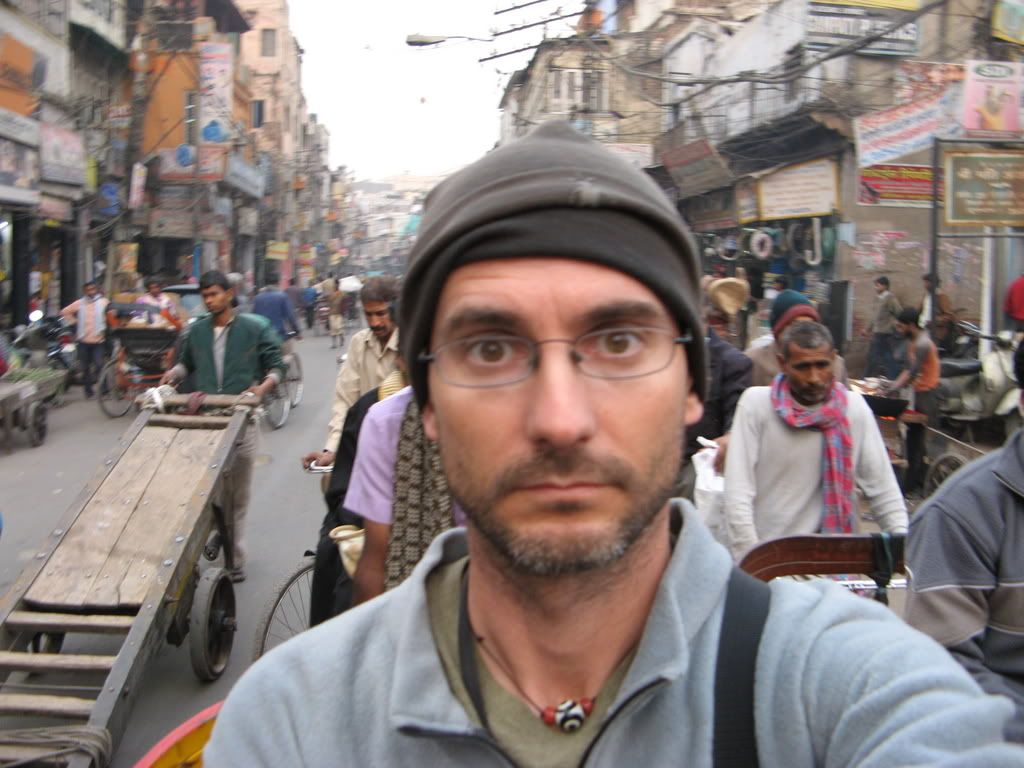
Delhi, as you may have guessed, hasn't been my favorite part of the trip, but there were a few highlights. Riding around the madness of Old Delhi on a bicycle rickshaw was one:


On my second day there was a festival/parade down the street in front of my hotel. It was put on the Sikhs, one of India's religious groups. They're the ones that wear the turbans (apparently there is a star Sikh cricket player called the "Turbanator"). They were giving out free food (good, too!) and it was quite a party, although the "marching bands" sounded terrible. I was touched to have people in the parade hand me crackers and some kids share their oranges with me.


I also visited the place Mahatma Gandhi was assassinated on January 30, 1948. He would take part in nightly public prayer-meetings on the grounds of the house where he was staying and was shot and killed there by a Hindu extremist. The house is now a museum. As you wind your way through the house, exhibits tell the story of Gandhi's life from the early years on; when you get to his last hours, you end up in his room where the handful of his worldly possessions are displayed, including his glasses and walking cane. From there you follow concrete footprints that lead to the back garden, marking his final steps that evening. The footprints end at a small memorial where he fell. Gandhi is one of my heros so it was a very poignant, moving experience for me. I'll leave you with a couple of Gandhi quotes that seem especially relevant for us today:

"What difference does it make to the dead, the orphans, and the homeless, whether the mad destruction is wrought under the name of totalitarianism or the holy name of liberty and democracy?"

"An eye for an eye makes the whole world blind."

Wednesday, December 12, 2007

The Bad with the Good

I debated about whether I should write this post or not. I don't want to worry anyone, but I also want to give you my experience as it is, not just the rosy highlights.

Delhi has been difficult.

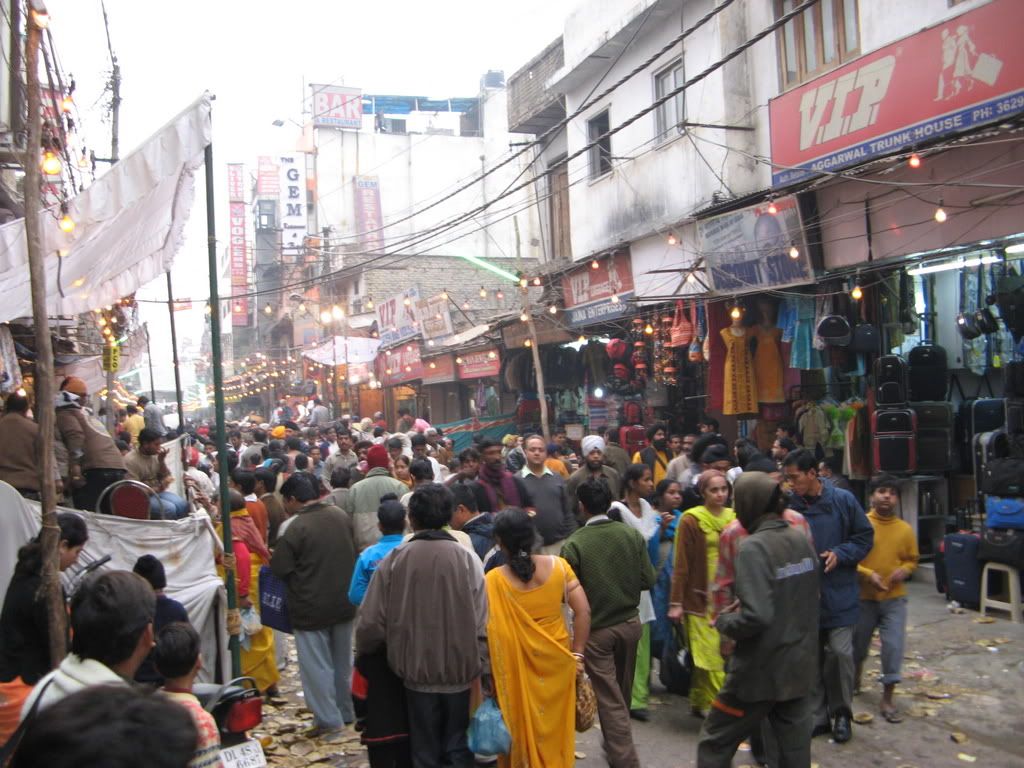
I've traveled to many parts of the world and, as you saw in an earlier posts, been on the receiving end of a lot of scams. I think of myself as a pretty smart, intuitive guy and even when I was getting taken advantage of, I was at least somewhat aware of what was going on and was more the victim of lack of information--not knowing the worth of something, perhaps. But here in Delhi, I've seen deception that borders on a con game. Apparently the tour business is rather cutthroat and the money big enough to warrant the lengths these companies go to. Since I arrived three days ago, pretty much anyone who's approached me has been a tout, someone hired to lure people into a shop or business. Invariably, it starts with, "What country are you from?" It's obvious what's going on and sometimes I'll chat and sometimes I'll ignore them. That's all fine, but, as you can imagine, it gets a old quickly. Although sometimes it can be helpful.

I was in the post office a couple days ago when a "very nice man" came up to me when it was obvious that I was at a complete loss as to where to begin. He translated with the woman behind the counter, walked me down the street to where I could purchase packing material, helped me again at counter back at the post office. Through this he gradually steered the conversation to travel agencies and some confusing nonsense about how the India's one official tour agency had moved, etc. He then, almost as an afterthought, volunteered to walk me to the right place. By this time, it was obvious what was going on, and when we arrived, he just stopped, shook my hand and said it was nice to have met me. It was all very pleasant and I just walked on, no big deal.

Today really threw me, though. My plan was to mail some more stuff at the post office and then hit one of the Starbuck's-like coffee shops in the more upscale part of New Delhi to try and figure out where I want to go next. I sat down at a table next to two guys that seemed to be part of India's new economic prosperity; you could have easily transplanted them to downtown Denver and called them yuppies. They asked me what I was up to and after a few friendly exchanges they invited me over to their table. I was loving it, I felt like I was finally getting to know a couple locals. Their English was great and they gave me some great ideas on places I might want to visit, we even talked about George Bush for a while. One had to leave. After he left, I asked the other guy what he did for a living. "Insurance company," he said. I was completely disarmed. I was asking about some places to visit after my coffee and had my Lonely Planet open to the map of the area. He made a point of showing me the official tourist office which was listed on the map. "Be sure to go to this one," he said. I laughed and commented on all the scam artists. "Oh yes, be careful, they're everywhere." I payed for my coffee and we got up to leave together, him saying, "yes, he'd better get back to work." I was enjoying our conversation and walking along with him. The tourist agency was right around the corner and he casually pointed it out to me and we said goodbye. I walked in, anxious to get a plan together. As I'm sure you know already, it wasn't the official agency. The next thing I know I've got this travel agent with a $2000 plan for my next two months, including a personal driver through Rajasthan. When I balk at that, he's got a $1000 plan. "Okay, thanks for the information, I'll think about it." Next came the high pressure sales. They make you feel like you've just spit in their face because you won't sign a contract right then and there. I started making my way towards the door as graciously as I could. When I got outside, somebody else was there leading me over to one of their cars and a driver. "Just take a short tour around the city for only 200 rupees, see how you like the service." I declined. "Okay, take the tour on us, if you don't like it, no problem, we part as friends." I don't know why, I knew better, but I got in the car. We drove around for a little while and returned to the agency. I knew what was coming. It's a different set of guys and they and the driver are asking about the 200 rupees. "Sorry, the other person said it was on you," I said. I was given the spit-in-the-face treatment again and told to, "have some respect and at least tip the driver." which I did since I was planning on it anyway.

For whatever reason, I haven't been able to meet and hook up with any fellow travelers so I feel very alone here. The constant deception and harassment has left me feeling alienated and bitter. The air pollution is terrible; there is a constant, surprisingly thick haze. The noise is constant and I think that if there is a hell, it will be filled with the sounds of motorcycle and car horns. A couple of days ago, I saw a guy begging that was as disfigured and pitiful as I've ever seen, his eyes clouded and different body parts missing, covered in dirty bandages. On the walk to my hotel after the that last tour agency incident, I had a woman with baby walking along side of me for a few blocks begging for money. "One rupee sir, please, feed my baby." I was tired, had too much caffeine, not enough water and watched while my heart struggled with whether to end my discomfort by reclassifying her from "struggling human being" to "irritant." My heart was breaking but I don't know if it was for her or for me. Sometimes suffering seems so big that if I really let it in, all of it, mine and everyone else's, it would destroy me. Is that true? I don't know.

Sunday, December 9, 2007

Welcome to India and f#*k you

So, as I went mentioned in my last post, I had heard it might be a challenge just to get to the hotel without being scammed. Guess what?

It went like this: I picked a hostel out of the Lonely Planet (the most popular guide for budget and adventure travel) in the area I wanted. I got a prepaid voucher for a taxi at the airport--this part is on the up and up. Once in the taxi, the driver mumbled something about not knowing exactly where it is but, "he'll find out." Oh, first I should mention that I only picked up my Lonely Planet India this morning since it's heavy and I was waiting to trade my Lonely Planet Nepal for a discount. On the flight I read that it's best to book your Delhi hotel ahead of time as the best places fill up fast and many of them will provide an airport transfer if you have a reservation. Oh well, too late for that. I then read a half page on the many taxi scams. Okey dokey.

So, I got in the cab and we were off. We had the now familiar taxi driver conversation about where I'm from, how long I'm in India, etc. He seemed nice enough and I started to relax, thinking maybe I won't have to worry about this one. In my experience, the Lonely Planet, understandably, has to tell you the worst of it. But about twenty minutes later he pulls up in front of a "travel agency" and goes into the office, ostensibly to find out exactly where the hostel is. "Oh shit, here we go," I thought. Sure enough, he comes out and says, "can you come in?" This is almost exactly how the Lonely Planet describes it: They taxi driver takes you to a travel agency on some pretense, then they call your hotel to make sure your reservation is in order. Lo and behold, "the hotel is full and they don't have your reservation. Oh dear, that's too bad, but I happen to know another hotel that can take you." They even put you on the phone with your "hotel," but it's actually a confederate playing the part.

I was having none of it. Those of you that know me well, know that it takes a lot for me to lose my temper and how much I shy away from confrontation, but you should have seen me in this office. First of all, the area of Delhi that I was going to is a stretch of road about a half mile long and one of the more popular places for backpackers, so this line about not knowing the location of the hostel was obvious BS. Secondly, there's no reason the hotel has to confirm my reservation if the agency is just calling for directions. The "travel agent" and I were soon in a shouting match. He was trying to put me on the phone with the "hotel," wondering why I was being so difficult when he was only trying to help. I was demanding to just be taken to the hostel, that there was no reason to check my reservation. I eventually just stormed out of the office. Luckily, the driver was waiting outside and less willing to get into it with me. Strangely, he still seemed like a decent guy and didn't put up a fight when I said just take me to a corner near the hostel--all of this obvious on the map, by the way. Golly, wouldn't you know it, all of a sudden he knew exactly where the place was.

Well, fortunately the hotel had a room and I had some terrific Chicken Tikka Masala for dinner (who knew the Indian food would be so good here) so all's well. And now I'm off to bed.